The North West figures
The Department for Energy Security and Net Zero publishes cost statistics drawn from MCS-certified installations. For 2025/26, published on 28 May 2026, they cover 22,981 MCS-certified installations in the North West: 16,496 of up to 4 kW, at a mean of £2,021 per kW, and 5,670 of 4 to 10 kW, at £1,768 per kW (DESNZ).
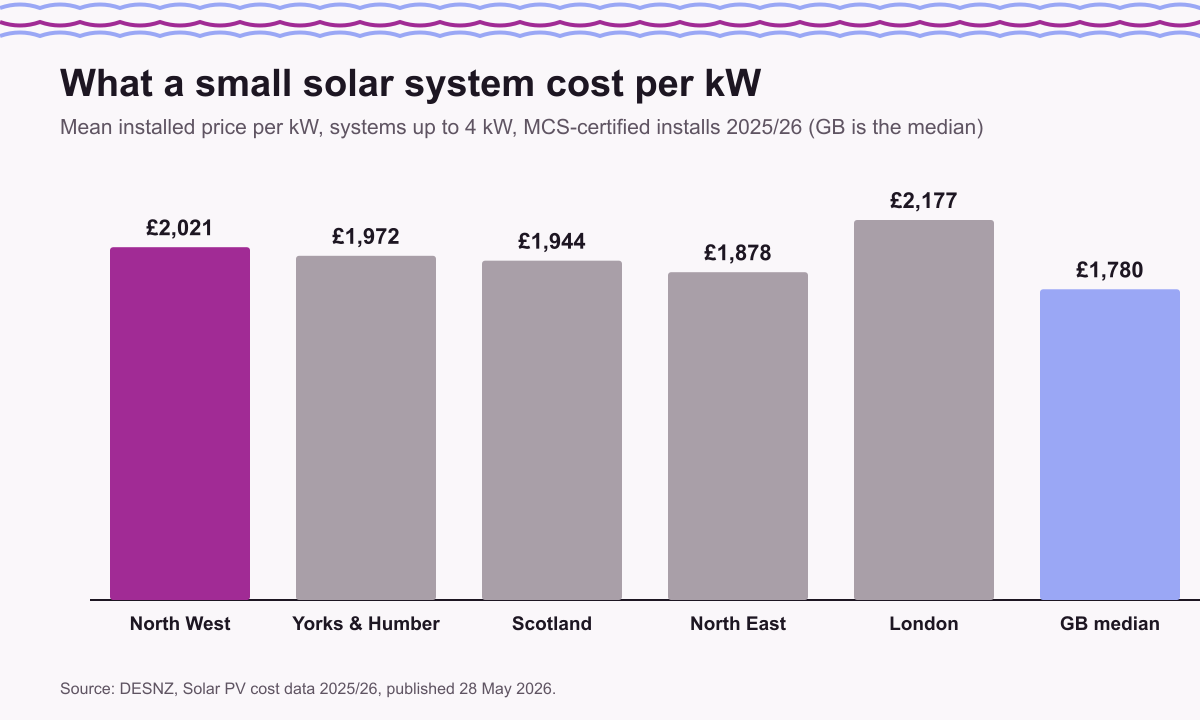
The North West sits towards the top of the regions for small systems, above the GB median of £1,780, though below London. That is why this guide compares Wigan quotes with the regional figure rather than a national headline. A national "average price" quoted in an advert may simply be from a cheaper region.
Common sizes at the North West means
The table puts common sizes against the regional means and the PVGIS output for a south roof at 35° in central Wigan, 927 kWh a year per kW (PVGIS 5.3). The totals are our arithmetic, rounded to the nearest £50. The Energy Saving Trust treats 4.5 kWp as a typical home system (Energy Saving Trust).
| Size | Mean per kW | About | kWh a year |
|---|---|---|---|
| 2 kW | £2,021 | £4,050 | 1,854 |
| 3 kW | £2,021 | £6,050 | 2,781 |
| 4 kW | £2,021 | £8,100 | 3,708 |
| 5 kW | £1,768 | £8,850 | 4,635 |
| 6 kW | £1,768 | £10,600 | 5,562 |
The jump between 4 kW and 5 kW is the band boundary, not a real fall in price at that size: the means describe two groups of installations, and a 4.5 kW quote could reasonably sit between them. Use the quote checker for your own figures.
Adding a battery
DESNZ also publishes battery prices for existing homes. In 2025/26 the median was £1,300 per kWh for batteries under 6 kWh, £890 from 6 to 11 kWh and £630 from 11 to 30 kWh (DESNZ). Larger batteries cost less per kWh, much as larger solar systems cost less per kW. If a quote bundles a battery, ask for it on its own line so each part can be compared. Batteries in Wigan homes
What moves a real quote up or down
- Access and scaffolding. A tall gable, a conservatory below the roof or a terrace fronting the pavement all add to the scaffolding.
- The roof itself. Slate, old tiles or a roof that needs repairs first; a hipped semi has less room on each slope than a gabled one.
- The kit. Panel make and warranty, the inverter type, and optimisers where chimneys or dormers cast shade.
- The wiring. A long cable run to the meter, a consumer unit that needs replacing, or a three-phase supply.
- Extras. Bird mesh, monitoring, a diverter for hot water, or a battery.
None of these is a reason to accept a high price without question. Each is something a quote should name on its own line, so you can see what you are paying for. See what a quote should include.
What a gap from the mean looks like in pounds
The quote checker reports a quote as a percentage above or below the North West mean. To turn that into money, the table takes three sizes that suit common Wigan roofs and shows the mean total, and what 10% and 20% above it would come to, with the yearly output of a south-facing roof in Hindley beside them (our arithmetic from DESNZ and PVGIS 5.3).
| Size | At the mean | 10% above | 20% above | kWh a year, Hindley, south |
|---|---|---|---|---|
| 3 kW | £6,050 | £6,650 | £7,300 | 2,769 |
| 4 kW | £8,100 | £8,900 | £9,700 | 3,692 |
| 6 kW | £10,600 | £11,650 | £12,750 | 5,538 |
A 20% gap on a 4 kW system is about £1,600, by our arithmetic: enough to ask about, but not on its own a reason to walk away. A quote that includes scaffolding over a pavement, optimisers for a shaded slope and a longer panel warranty can fairly cost more than the regional average. The useful question is what the extra buys, line by line, and what a quote should include walks through those lines.
Who pays, by tenure
Who meets the cost depends on who owns the roof. At the 2021 Census, 34.4% of Wigan households owned their home outright and 32% with a mortgage; 17% rented from a social landlord, 14% of all households from the council itself, and 15.9% rented privately (Census 2021). For owners, the regional figures on this page are the yardstick. For tenants the landlord decides and pays. Private landlords with homes at EPC D or E, and lower-income owners at EPC D to G, can look at GMCA's grant where the household qualifies on income, benefits or postcode (see help with the cost). In 2024, 9.8% of the borough's households were in fuel poverty (DESNZ), the group that grant is aimed at.
VAT and timing
Installed solar panels and batteries in homes are zero-rated for VAT until 31 March 2027; from 1 April 2027 they carry 5% (HMRC). On a 4 kW system at the North West mean that is roughly £400 more, by our arithmetic. The rate that applies depends on when the work is done, so a quote for work early in 2027 should say how it treats VAT.
For lower-income households, GMCA's Warm Homes: Local Grant can cover solar and batteries; for everyone else there is no grant, but there are loans. See help with the cost.